



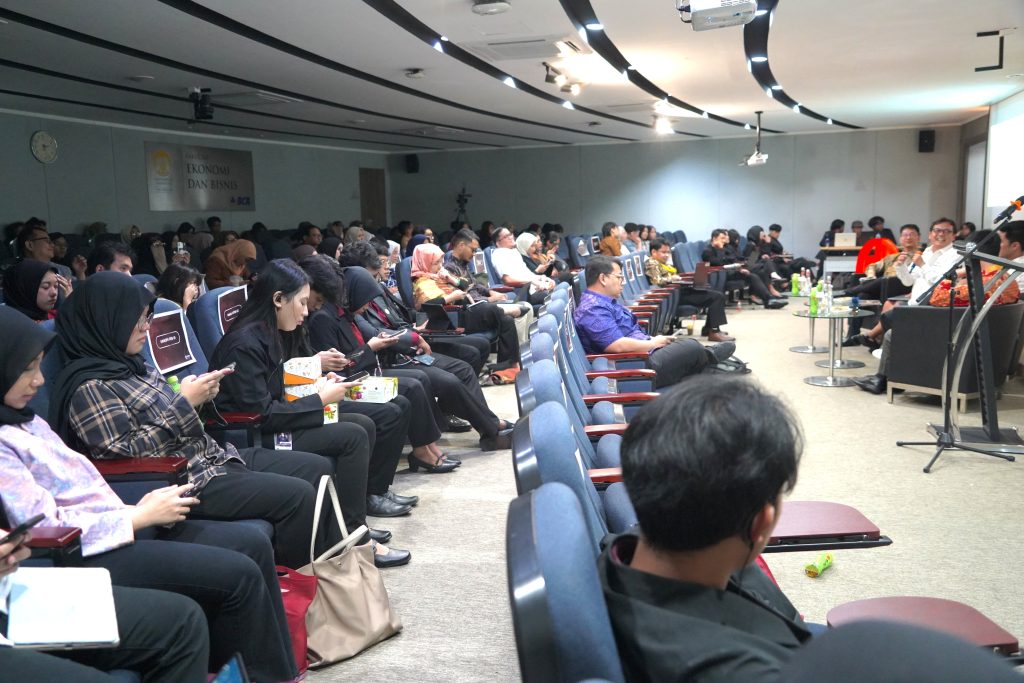
JAKARTA – Executive Director of The PRAKARSAVictoria Fanggidae was one of the speakers at the Indonesia Economic Outlook (IEO) 2027 Forum panel discussion held by KANOPI FEB UI at the BCA Auditorium, MM FEB UI Salemba, Jakarta, on Monday (September 28, 2026). The theme was “Fiscal Discipline in a Changing Landscape: Reassessing Indonesia's Fiscal Space Amid Domestic Priorities and Global Pressures”, The PRAKARSA highlights the vulnerability of Indonesia's fiscal space amidst surging debt burdens, climate risks, and unequal allocation of tax incentives.
In her presentation, Victoria revealed that Indonesia's fiscal capacity is currently under increasing pressure due to increasing debt interest payments, which are projected to reach IDR 650,3 trillion in the 2027 Draft State Budget, or absorb around 19% of total state revenue.This number has almost doubled compared to 2021.With total government debt exceeding Rp10.000 trillion as of June 2026 (41,26% of GDP), budget management is deemed to require extra caution to prevent further narrowing of public spending flexibility..
In addition to the debt burden, The PRAKARSA assesses that the macro assumptions of the State Budget are at risk of being exceeded due to global dynamics, such as the Indonesian crude oil price (ICP) reaching US$89,43 per barrel and the rupiah exchange rate at Rp17.855 per USD as of September 2026.Victoria emphasized that the government's 2027 economic growth target of 6,0% is considered overly optimistic compared to projections from international institutions such as the World Bank, IMF, and ADB, which are in the range of 5,0% to 5,2%..
Victoria also criticized the misalignment between the threat of climate disasters and state budget allocation policies. While the very strong El Niño phenomenon is hitting and threatening the food, energy, and employment sectors, the government is cutting the budget ceiling for the National Disaster Management Agency (BNPB) by 75,6% and the Ministry of Agriculture by 30,2%. These cuts are considered to have the potential to weaken national resilience and food security amid the climate crisis.
From the fiscal justice perspective, The PRAKARSA highlighting the high tax incentives or spending which is projected to reach IDR 607,7 trillion in 2027The amount of the tax incentive is considered odd because it actually exceeds the allocated social protection budget of Rp. 549,9 trillion, amidst the tax ratio (tax ratio) Indonesia is still at the lowest level, namely 9,31% in 2025.
These fiscal challenges are further exacerbated by shifts in population structure, with Indonesia's demographic bonus expected to end around 2037–2041.With the proportion of the elderly population projected to rise to 20,31% by 2045 and only 19,8% of workers covered by pension benefits, the burden on the state budget for health care and social protection for the poor elderly is certain to increase sharply in the future..
Responding to these various conditions, The PRAKARSA convey strategic recommendations, including urging the progressive expansion of the income tax base for high-income individuals, as well as transparent audits and the implementation of time limits (sunset clause) on tax incentives. In addition, the government is encouraged to set a lower limit for the disaster mitigation and basic services budget, and to publish fiscal risk sensitivity simulations periodically to the public..
As a concrete step to face the threat of poverty in old age, The PRAKARSA encourage the government to start preparing a social pension scheme for poor seniors aged 70 years and above starting in 2027The government is also being asked to cover old-age security contributions for poor informal workers to ensure fiscal justice and long-term social sustainability..