

JAKARTA – The implementation of the Indonesia–European Union Comprehensive Economic Partnership Agreement (EU-Indonesia CEPA) and the Corporate Sustainability Due Diligence Directive (CSDDD) has the potential to depress wages and the bargaining position of vulnerable workers in the palm oil sector if not accompanied by strong social dialogue. Program Director of The PRAKARSA, Yuanda Pangi Harahap, warned that rising compliance costs resulting from due diligence rules risk being passed on to smallholder farmers (smallholders), daily workers, migrants, and female workers.
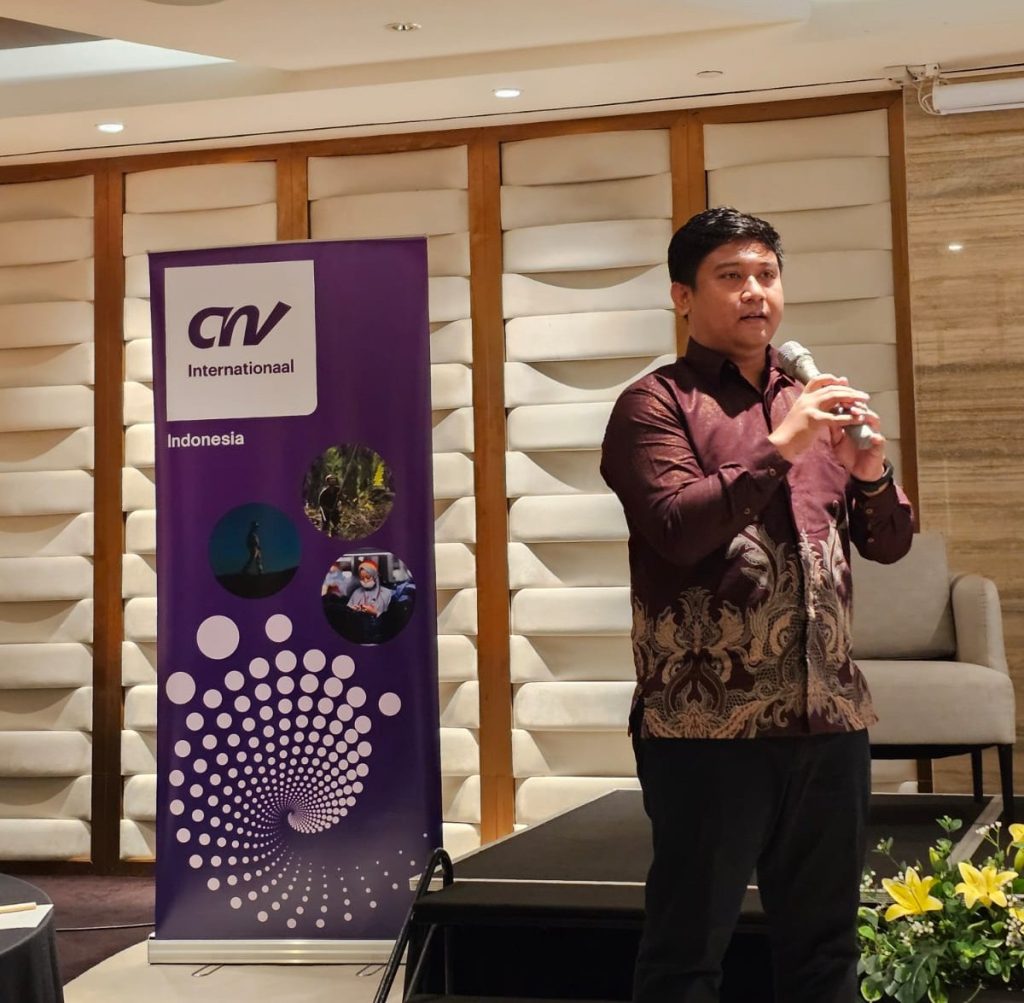
Yuanda conveyed this urgent message when he was a resource person in a stakeholder dialogue entitled “EU-Indonesia CEPA, CSDDD and Responsible Palm Oil” organized by CNV International at the Ashley Wahid Hasyim Hotel, Jakarta, Monday (28/9/2026)This forum brings together representatives from government, labor unions, employers, and civil society organizations to discuss the future of labor protection in the national palm oil supply chain..
In his presentation entitled “EU–Indonesia CEPA: What It Means for Workers' Rights and Social Dialogue”Yuanda acknowledged that the CEPA has potential positive outcomes through trade and investment certainty. The non-regression clause also ensures that labor standards will not be lowered for competitive advantage, and has the potential to encourage the implementation of core ILO conventions on OSH and the prohibition of forced labor.
However, Yuanda emphasized that there is a real threat of a surge in traceability compliance costs which could squeeze plantation business margins.This situation is likely to worsen the working conditions of migrant workers, contract workers, and female workers who are often in the informal sector or on contract basis.. In addition, gaps in national law enforcement, such as the implications of the 2020 Job Creation Law, are considered a fundamental challenge in proving the CEPA commitment..
Regarding the effectiveness of the labor chapter in the CEPA, The PRAKARSA presents two contrasting global perspectives. The ETUC (2025) assessment considers the CEPA labor clauses to be binding (binding) and provide bargaining power for workers, while the Arbeiterkammer Wien/PowerShift report (2026) assesses that these provisions are still too weak and vague to address the gap in the enforcement of workers' rights in Indonesia.
To ensure that this trade agreement truly protects workers' rights, Yuanda outlined four formal mechanisms included in the CEPA. These mechanisms include the establishment of Domestic Advisory Group (DAG) in Indonesia and the EU, Civil Society Forum (Civil Society Forum/CSF), periodic intergovernmental dialogue, to state-to-state dispute resolution schemes (state-to-state dispute settlement).

Yuanda emphasized that the mechanism's effectiveness relies heavily on unions' active monitoring of implementation at the plantation and factory levels. Unions are urged to secure representation in the Indonesian DAG, document labor violations in detail, utilize the CSF to network with European unions, and detect potential non-regression clause violations early.
On the other hand, The PRAKARSA urge palm oil entrepreneurs and companies to actively participate in DAG and build a complaint handling mechanism (grievance mechanisms) which is credibleEntrepreneurs are expected to not only fulfill compliance formalities, but also prioritize transparency and social dialogue to create a sustainable and equitable palm oil supply chain..