

By: Setyo Budiantoro
Antonio Guterres arrives in Indonesia at a crucial time for the organization under his leadership. The UN Secretary-General since 2017 is pushing for major reforms through the UN80 Initiative, while the Sustainable Development Goals (SDGs) are entering their final years, with only about 15 percent of the targets on track to be achieved.
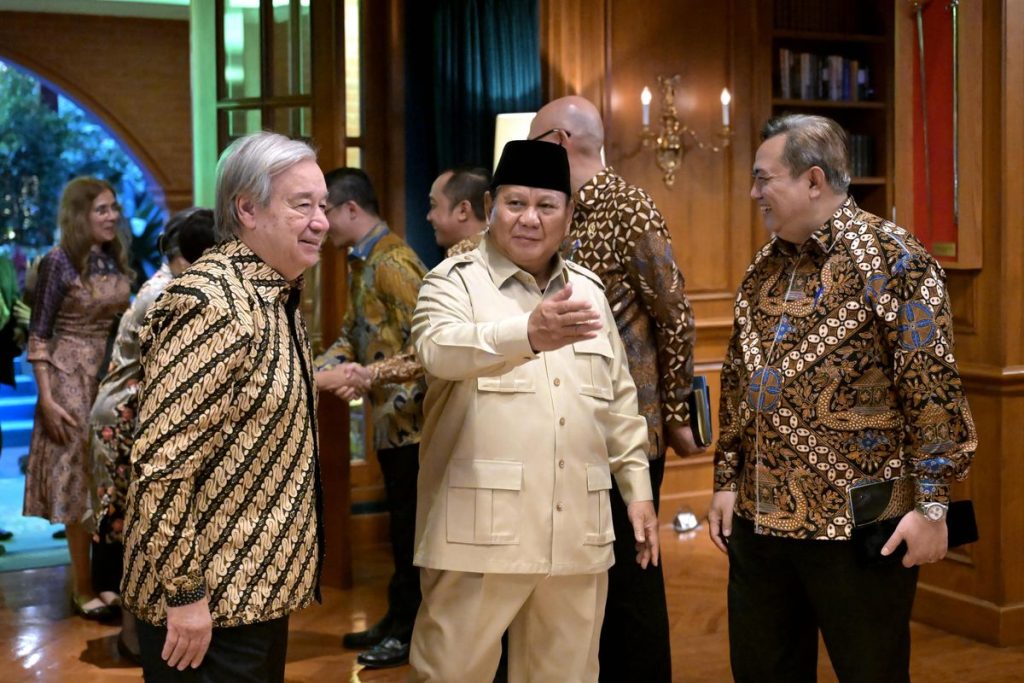
On Sunday (October 18, 2026), Guterres met with President Prabowo Subianto in Hambalang to discuss various global issues and the importance of strengthening multilateral cooperation. However, his visit is interesting to read beyond a mere diplomatic agenda. He arrives at a time when the world is beginning to question whether the system of international cooperation, built over more than eight decades, is still adequate to address the challenges of our time.
Before leading the UN, Guterres served as Prime Minister of Portugal and for a decade led the UN refugee agency, UNHCR. Now his challenge is greater: not just responding to humanitarian crises, but helping to reform an international system that is increasingly struggling to prevent conflict, address crises, and deliver on development promises.
That's the crucial context for the UN80 Initiative. Guterres himself has stated that "the status quo is untenable." However, the issues of multilateralism may be deeper than simply how to make the UN more efficient.
The world is not lacking in goals and commitments. We have the Paris Agreement, the 2030 Agenda and the SDGs, various development financing agreements, biodiversity targets, and commitments on trade and technology.
Nearly every major global issue has conferences, declarations, targets, and institutions. The problem lies in the gap between agreements in the conference room and real change in people's lives.
The SDGs provide the clearest picture. After more than a decade of implementation, of the 139 targets with adequate progress data, only about 15 percent are actually on track to be achieved. This doesn't mean the SDGs have failed to produce progress. Real gains have been made in health, education, energy, clean water, social protection, and other areas.
However, the 15 percent figure remains a stark warning: the time to 2030 is rapidly approaching, and most global ambitions are not yet moving at sufficient pace. Therefore, the question isn't whether the world still needs a common goal. We definitely need one.
The more difficult question is why, once goals are set and commitments are made, so many remain elusive. One answer lies in something fundamental: financing.
Developing countries still face a financing shortfall of approximately US$4 trillion annually to achieve the SDGs. At the same time, approximately three billion people live in countries where government debt interest payments exceed spending on health and education combined. Many countries that need investment most are facing the highest capital costs.
However, the problem isn't just a lack of money. Trillions of dollars continue to move through banks, capital markets, pension funds, investment firms, governments, and international development institutions. The issues also concern who can access capital, how much it costs, how risk is shared, where capital is allocated, and what results emerge from the use of that money.
The last question is often overlooked. We're accustomed to measuring success by the magnitude of inward investment, the amount of private capital mobilized, or the growth of green bonds and other sustainable-labeled instruments. While these are all important, there's a fundamental difference between financing mobilization and development. A billion dollars mobilized doesn't necessarily equate to a billion dollars in development. The value of development is only seen when the money is put to work.
Does investment make domestic firms more productive? Do technology and knowledge transfer? Do local businesses enter the supply chain? Do workers gain better skills and incomes? Is the environment healthier? And how much added value actually stays in the communities and regions where the investment takes place?
This question is crucial as the world discusses energy transition, inequality, and sustainable finance. Nearly all countries can agree that clean energy must be accelerated. While renewable energy projects are significantly more expensive in developing countries due to high capital costs, a similar global agreement doesn't create the same capacity to act.
We can also agree to reduce inequality, but if the benefits of technology and growth flow primarily to a few capital owners while the incomes of the majority of workers only increase slightly, the economic system will continue to produce inequality. The same is true for sustainable finance. The world can issue more green bonds or label more investments as "sustainable."
However, labels don't automatically translate into sustainable development. The metrics must be based on results: whether emissions are truly reduced, local economic capacity increased, jobs improved, and communities bearing the costs of the transition benefited. This is where the discussion on the post-2030 world needs to move further. We don't need to abandon the SDGs. The SDGs' experience demonstrates the importance of a shared global direction.
However, that direction must be more strongly connected to the economic rules, incentives, institutions, and accountability mechanisms that determine how money and power operate. In other words, the post-2030 question is not simply: what development goals do we want to achieve next? The question must also include: what kind of economic and financial system will make those goals truly achievable?
One of the changes needed is to move from simply mobilizing finance to making finance accountable for development outcomes. Simply put, money used in the name of development must be accountable for tangible results. This doesn't mean all investments should be turned into social programs. Investors still need profits, companies still need to be productive, and markets still have a vital function.
However, when an investment receives government guarantees, state incentives, development funds, multilateral facilities, tax breaks, or sustainability labels, there is a natural question: what additional development benefits does such support bring?
In development, this question is known as development additionality: what happens because of the funding and what might not have happened without it. This concept is important because it prevents us from equating every dollar of investment with additional development. This is where we might need something like a development balance sheet.
A regular financial balance sheet shows where money comes from, where it's spent, and whether investments generate profits or losses. A development balance sheet must answer different questions: how public support or development financing is converted into additional economic, social, and ecological capacity, and to whom the added value ultimately flows.
This is different from simply measuring impact after a project is completed. A development account must, from the outset, link sources of financing and public support to new capacities, social and environmental changes, and the distribution of benefits and risks. Imagine a project receiving a $1 billion investment. We need to know whether that investment is actually realized, but the assessment shouldn't stop at the investment figure.
We also need to understand additional production capacity, the number of qualified jobs, technological improvements, the environmental impact, and who benefits and who bears the risks. With such metrics, the question of development changes. We no longer simply ask how much investment comes in, but what results from that investment.
It's not just how much green finance is issued, but whether emissions are reduced and who benefits from the transition; it's not just how much infrastructure is built, but whether development actually improves regional productivity and people's lives. Indonesia has strong legitimacy to bring these kinds of questions into the global conversation.
We are a member of the G20 and BRICS, one of the largest economies in the Global South, a country with vast natural resources, an issuer of various sustainable financing instruments, and a country undergoing large-scale industrial downstreaming and energy transition. Indonesia is not observing the contradictions of global development from the outside; we are experiencing them ourselves.
We need foreign investment, but we also need investment that strengthens the domestic economy. We need downstreaming, but its success cannot be measured solely by increasing export value.
We also need to see whether technology is increasingly mastered, workers become more productive, Indonesian companies upgrade, and more added value stays within the country. We need a green transition, but it's hard to call it successful if society bears the majority of the social and ecological costs while the economic benefits are concentrated in a few.
We also need economic growth, but growth is not an end in itself. It is a means for people to obtain better jobs, more decent incomes, better education and health care, a safer environment, and a wider range of life choices.
Therefore, Guterres' visit can also serve as a reminder that Indonesia need not be satisfied with merely playing the role of bridge builder between developed countries and the Global South. Being a bridge remains crucial as geopolitical rivalries intensify. However, a bridge doesn't just need to connect two sides; we also need to ask where it leads.
Indonesia can bring more substantive questions to the discussion about the future of multilateralism: not just how to bring countries back together, but how to ensure that global cooperation transforms economic decisions and capital flows into countries' ability to develop and improve the lives of their people.
In this perspective, multilateral development bank reform, debt restructuring, climate finance, international taxation, trade, technology transfer, sustainable investment, and industrialization all converge on the same question: do global rules and capital flows enhance countries' capacity for development, or do they actually diminish it?
This question is increasingly important as the time to 2030 draws near. We must continue to pursue as many SDG targets as possible, but the conversation about what comes after 2030 must also begin now. The world cannot simply create a list of new goals.
We need to link goals to rules, commitments to incentives, financing to institutions, and then test it all through accountable development outcomes.
This is where the UN Secretary-General's visit to Indonesia takes on greater significance. Guterres arrives at a time when the UN is questioning how multilateralism must evolve after more than eight decades of existence. Indonesia is also facing similar questions: how growth, investment, downstreaming, and the energy transition can truly translate into prosperity.
These two questions converge at a point. Multilateralism will not gain legitimacy simply because countries produce more declarations or hold more summits.
Legitimacy will grow if people can see the global system truly working for their lives. More than eighty years after the UN was founded, and as its Secretary-General comes to Indonesia to discuss the future of international cooperation, perhaps there is one question worth bringing to the post-2030 conversation: when trillions of dollars are being spent in the name of development, who is that development for—and what has really changed?
____________________
This article was first published in kompas.com
Setyo Budiantoro is a Sustainable Development Expert at The Prakarsa, an IDEAS–UID Fellow at MIT Sloan School of Management, an SDGs–ESG Expert at the Indonesian ESG Professional Association (IEPA), and a member of the Fair Finance Asia Advisory Committee. He is a lecturer at the Sustainable Finance and Development postgraduate program at Udayana University. He is an assessor of SDGs, ESG, CSV, and CSR programs, as well as a learning strategy designer and trainer in writing reports, policies, policy briefs, and sustainability strategies. He actively shares his thoughts and experiences with ministries/local governments, the Financial Services Authority (OJK), the Indonesia Stock Exchange, companies, philanthropic organizations, CSOs, universities, and international institutions.