

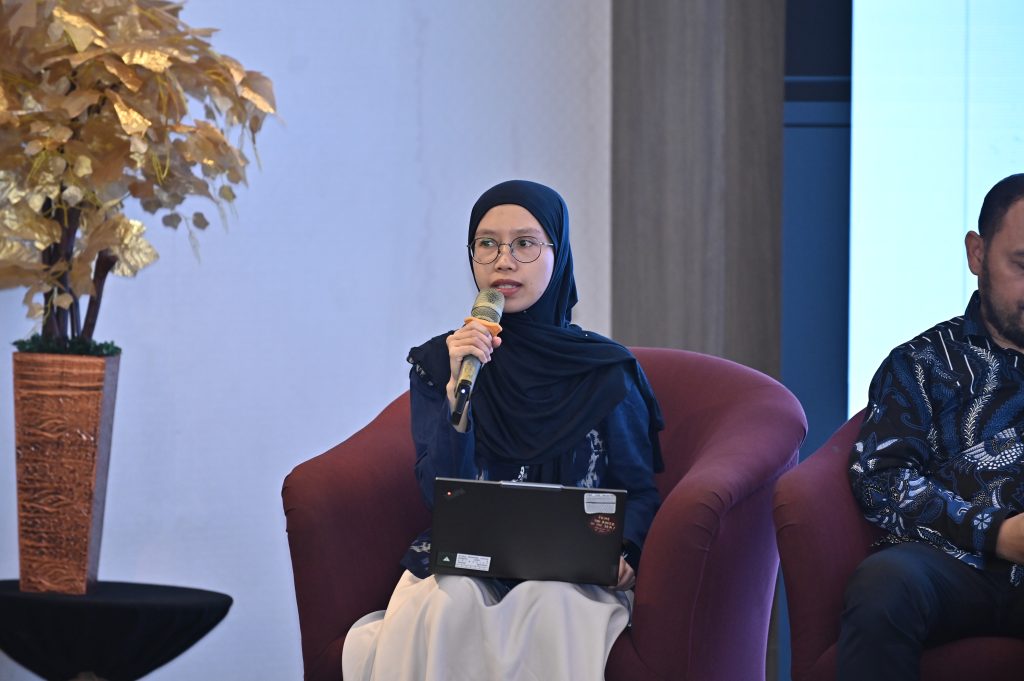
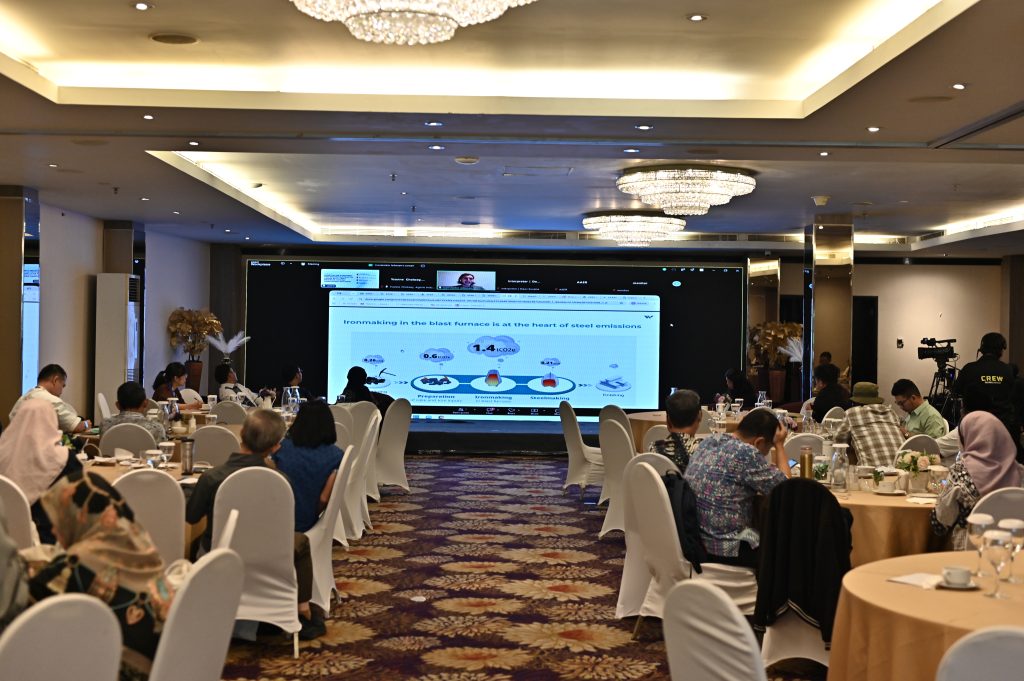
JAKARTA – Head of Sustainable Development The PRAKARSA Dwi Rahayu Ningrum attended the Conference “Accelerating the Steel Transition: Building a Competitive, Low-Carbon, and Responsible Steel Industry Road to COP31” in Jakarta, Tuesday (29/9/2026). In the multi-stakeholder forum, The PRAKARSA who is also part of the ResponsiBank Indonesia Coalition was present as a panelist at Panel Discussion 1 to explain the strategy and role of the financing sector in accelerating the green steel transition in Indonesia.
In his explanation, Dwi highlighted the significant potential financial and environmental risks resulting from the dominance of high-emission technology in the national steel industry. Currently, approximately 21 million tons of the total planned national steel capacity expansion still uses high-emission technology. Blast Furnace-Basic Oxygen Furnace (BF-BOF) is coal-based and supported by a steam-powered power plant (PLTU) captiveThis condition is considered to lock in carbon emissions for decades to come while creating the risk of stranded assets (stranded assets) for the banking sector.
The ResponsiBank Indonesia Coalition emphasized that Indonesian banks lack clear sector policies to limit financing to high-emission industries. Based on the 2024 ResponsiBank Ratings assessment, the average score for Indonesian banks on climate change was only 1,5 on a scale of 10. Furthermore, credit exposure of national banks and public financing institutions to fossil-fueled steel producers and coal-fired smelters is significant. captive is still considered very high without being accompanied by strict decarbonization criteria.
To address this gap, the ResponsiBank Indonesia Coalition is urging the Financial Services Authority (OJK) to tighten the criteria in the Indonesian Sustainable Finance Taxonomy (TKBI). The TKBI is expected to eliminate the "Transition" or "Green" labels for factory expansions. blast furnace new or projects that rely on schemes Carbon Capture, Utilization, and Storage (CCUS). Instead, labels and financing incentives should be required to have drastically reduced emission thresholds and a scheme Transition Plan which is credible and verified.
In addition, financial and banking institutions are encouraged to immediately adopt a steel sector financing criteria policy that prohibits funding for BF-BOF and PLTU expansion. captive Banks are also required to provide their customers with transition plans aligned with the 1,5 degree Celsius global temperature target. This includes a clear retirement date for high-emission assets, technology transfer to renewable energy sources, and a commitment to renewable energy sources. Electric Arc Furnace (EAF) based on renewable energy, as well as the implementation of Human Rights (HAM) due diligence to the upstream supply chain.
The ResponsiBank Indonesia Coalition also emphasized the importance of enforcing environmental law and protecting public finances to prevent private parties from bearing climate risks. Fiscal incentives such as the Specific Natural Gas Price (HGBT) and Tax holiday should no longer be given to coal-based industries, but rather diverted to support the scheme feebate and the development of clean technologies such as Direct Reduced Iron (DRI) based on green hydrogen.
The conference, organized by the Ecological Action and People's Emancipation (AEER) together with the TARA Climate Foundation, brought together around 70 participants from technical ministries such as the Ministry of Industry, Bappenas, KLH, ESDM, OJK, as well as representatives of business actors, the IISIA association, KADIN, and international civil society organizations.This meeting produced joint recommendations ahead of COP31 to ensure Indonesia's steel transition is competitive, fair, and responsible..