

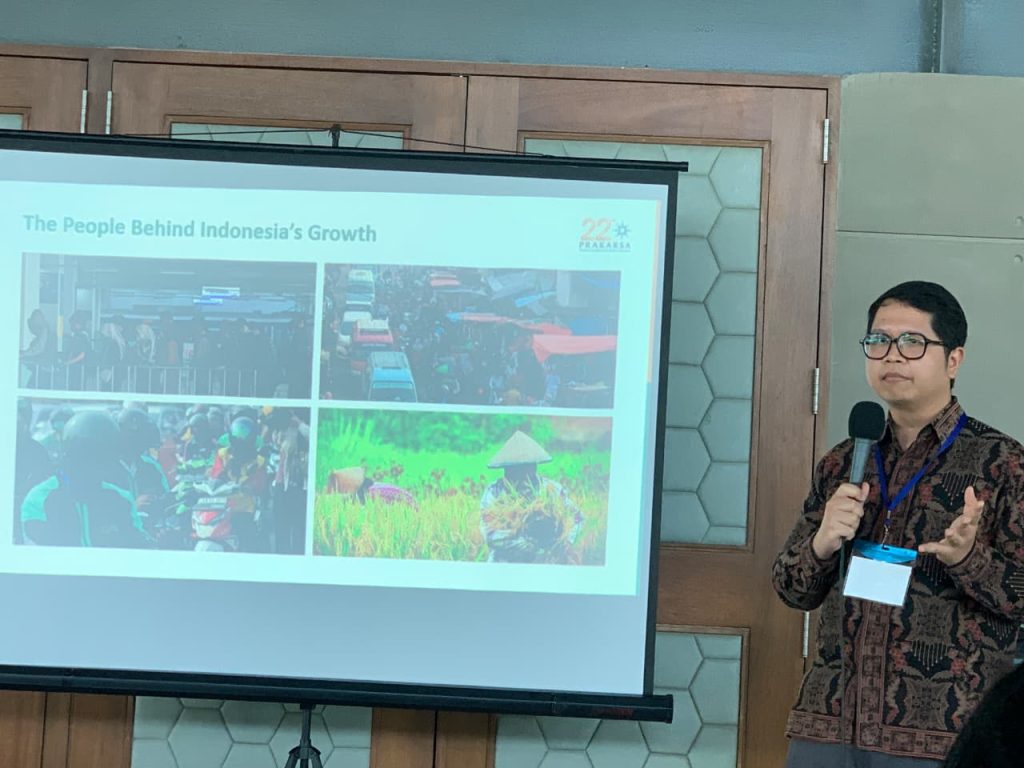
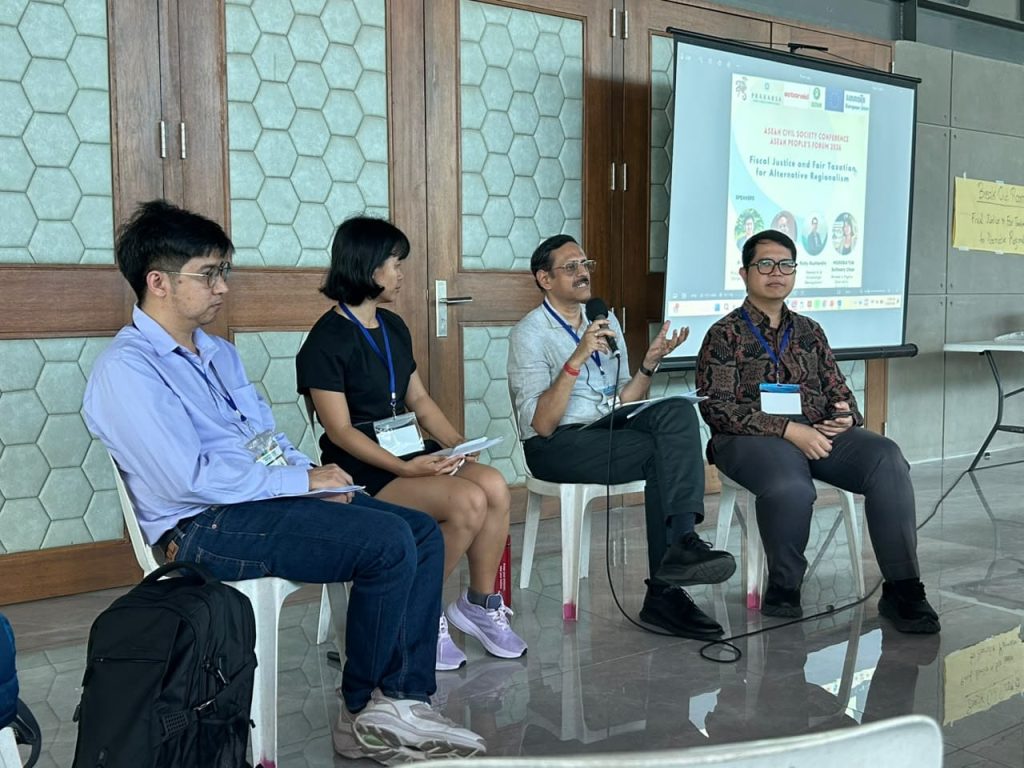
QUEZON CITY, October 28, 2026 – The PRAKARSA participated in the ASEAN Civil Society Conference/ASEAN Peoples' Forum (ACSC/APF) 2026, which took place on October 27–29, 2026, in Quezon City, Philippines. This annual ASEAN civil society forum carried the theme "Resist Business-as-Usual: Disrupt, Reclaim, Rebuild" and brought together civil society organizations, labor unions, grassroots movements, academics, and regional networks from Southeast Asian countries. PRAKARSA represented by Roby Rushandie, Research and Knowledge Management Director, who was a speaker at the panel session “Fiscal Justice and Fair Taxation for Alternative Regionalism” on October 28, 2026.
This session in the convergence space of Neoliberalism and Alternative Regionalism was co-organized by Oxfam in Cambodia, SCOPE-PFM Consortium, Budget Working Group, The PRAKARSA as the CAPTAIN Secretariat, Third World Network, and ActionAid Cambodia. Moderated by Sotheary Chun, the discussion featured Sok Pitour from Oxfam in Cambodia who shared his experience implementing Fair Tax Monitor in Cambodia, Roby Rushandie who discussed Indonesia's experience, and Jagat Patnaik from ActionAid International who highlighted fiscal justice from a regional perspective and the UN Tax Convention negotiations. This session aimed to generate concrete recommendations on tax justice, budget transparency, and social protection financing for the drafting team of the ACSC/APF 2026 Declaration.
In the regional context exposure, The PRAKARSA highlights Indonesia's economic paradox: stable, but not yet inclusive growth. Indonesia's economy is expected to grow 5,11% in 2025, and the poverty rate will fall to 8,07% by March 2026, but inequality will only decline slightly. About six in ten workers (59,3%) work in the informal sector, and the middle class will shrink by 9,5 million people between 2019 and 2024, even though this group accounts for about half of the taxes paid directly by households. Meanwhile, the richest 1% controls about 21% of the wealth, and the number of people with wealth above US$30 million will rise from 2.805 in 2021 to 3.833 in 2026. Roby summarizes this situation with the phrase, “The tax base is falling from the middle while wealth piles up at the top.”
This problem is compounded by a tax system that fails to reach the top. Indonesia's tax ratio was only 11,8% of GDP in 2024, the lowest among the eight ASEAN countries covered by OECD data and far below the Asia-Pacific average of 19,7%. VAT and sales tax on luxury goods account for around 43% of tax revenue, while only about 6% of adults file income tax returns. Overall, Indonesia's fiscal policy has only reduced inequality by 3,4 Gini points, far below Brazil's 14 points. "The question is not only how much we tax. It is who we tax," said Roby.
The PRAKARSA then presented the results of a simulation of a 2% minimum tax on billionaire wealth, following the design proposed by Gabriel Zucman for Brazil's G20 Presidency. Globally, the average billionaire pays income tax equivalent to only 0,3% of their wealth. By applying the 2% minimum standard to Indonesia's 48 richest families and taking into account valuation factors, tax avoidance, and collection capacity, the potential revenue is estimated at around US$3,2 billion per year, or approximately 0,2% of GDP, with a range of US$1,2–6,2 billion. This figure is a model estimate, not a revenue projection, but it suggests that significant funding sources could be raised from a handful of the richest families, rather than from the middle class.
This potential is not only relevant to Indonesia. The study PRAKARSA previously estimated that a 1–2% progressive wealth tax on large fortunes in six selected ASEAN countries could generate a gross potential of around US$37,5 billion per year. However, wealth is highly mobile. In the simulation, The PRAKARSA, five families control almost half of the taxable wealth, so a change in tax residency for just one family could significantly reduce revenue. “Wealth crosses borders, while tax enforcement remains largely national,” Roby emphasized that fiscal justice must therefore be a shared agenda for ASEAN.
Starting from three questions, namely who pays, who enjoys, and who decides, The PRAKARSA put forward three demands. First, ASEAN finance ministers are encouraged to open a workstream at the ASEAN Forum on Taxation on transparency of tax incentives, harmful tax competition, and taxation of extreme wealth. Second, additional revenue needs to be allocated to universal social protection, public services, and climate resilience, with gender-responsive budgeting. Third, ASEAN needs to develop a common position for an inclusive and redistributive UN Framework Convention on International Tax Cooperation, starting with the negotiating round in Nairobi on November 30–December 10, 2026, by involving civil society. This engagement is crucial because public participation in budgeting remains low: in the Open Budget Survey 2025, Indonesia's participation score was only 33 out of 100 and Cambodia's was 2 out of 100. As the Secretariat of CAPTAIN, the Asia-Pacific think tank network for tax justice, The PRAKARSA also invites partners to pioneer civil society fiscal justice monitoring at the regional level.

At the panel session, The PRAKARSA sharing Indonesia's experience in tax justice advocacy and social spending monitoring. Since 2022, The PRAKARSA Compiling estimates of the potential wealth tax and assessing its political support. The government itself still considers the wealth tax a long-term plan. In terms of spending, Indonesia's budget transparency score is 71, but public participation is only 33. PRAKARSA identified three key challenges: a narrow tax base amid economic vulnerability, concentrated and hard-to-detect wealth, and political and cross-border limitations that no single country can overcome alone.
The Participation PRAKARSA in ACSC/APF 2026 strengthens efforts to bring research evidence into the regional advocacy agenda. Input The PRAKARSA, namely taxing extreme wealth and ending harmful tax competition, spending revenues for the people, and building a common ASEAN position on inclusive and redistributive taxation, were also presented as session recommendations for the ACSC/APF Declaration 2026. Going forward, The PRAKARSA looking at collaborative spaces with regional partners, including through CAPTAIN, to strengthen cross-border evidence and advocacy ahead of the UN Tax Convention negotiations in Nairobi. Through its role as an evidence-to-policy bridge, The PRAKARSA encourage fiscal policy in ASEAN not only to pursue growth, but also to ensure that the results are enjoyed fairly.