

When Prabowo Subianto, then a presidential candidate in 2024, mocked the government for holding “too many focus group discussions [FGDs], and too little work on the ground,” he was diagnosing a real disease: bureaucracies that plan endlessly and act rarely.
Two years into his presidency, the diagnosis has flipped. It is true that a hefty share of public spending went into FGDs, seminars and workshops that produced little. But his own government now suffers the opposite failure of executing before it plans, then improvising the plan as the execution collapses. Yet the damage is already done, heavily.
The clearest evidence sits in two of Prabowo’s flagship programs. In the past two months alone, the free nutritious meal program and Red and White Cooperatives caught the spotlight for alleged corruption cases and changes to their implementation schemes, all traceable to planning that was never finished before rollout. For two programs that consume close to 10 percent of the 2026 state budget, about Rp 370 trillion (US$20.6 billion), the margin for error should be near zero, and the cost of mistakes is unimaginable.
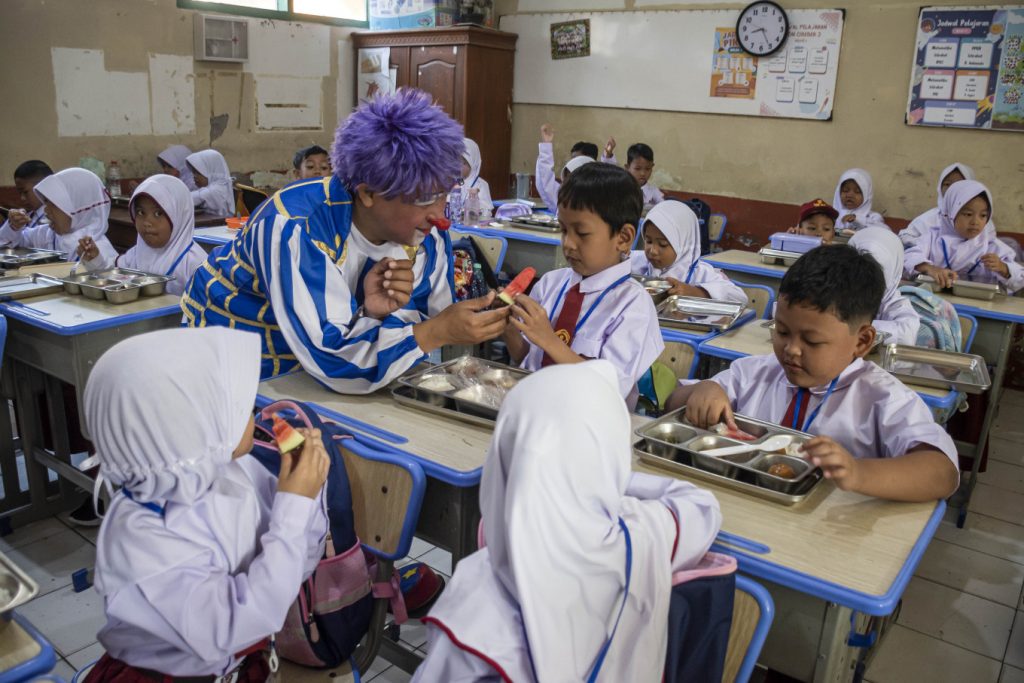
The pattern that is evident on the ground has followed the rule of “regulation chasing rollout”. It was not until seven months after the free meals program national rollout that the National Nutrition Agency (BGN) finally issued the long-awaited technical guidance for the program. Over that time period, at least 11,000 children suffered food poisoning, a toll that the President refers to as “only 0.0017 percent of the total recipients”.
Corruption cases that involved the BGN leadership, projected to reach Rp 1 trillion per month, bubbled BGN’s arrears to operators up to Rp 1.6 trillion, and many kitchens are stalled and have incurred financial losses.
And the toll did not stop where the President’s talking point implied it would. Case counts kept climbing well past that first wave: more than 9,000 children had fallen ill by October 2025, and watchdogs recorded another 1,242 fresh poisoning cases in January 2026 alone, a full year after the national rollout.
Two of these cases have since ended in death. An eight-year-old in North Bengkulu died in March after eating a burger distributed in an MBG package, and a two-year old in Cianjur died in April following a poisoning cluster that sickened more than 100 children in his village in a single week, a toll that the BGN has publicly disputed. Whichever way the lab results eventually land, the underlying fact does not change, the program is still expanding faster than its own safety systems can absorb.
A rather seldom discussed cost is the one paid by the elderly and people with disabilities. Late last year, Prabowo ordered the Social Affairs Ministry to scrap its existing food-distribution program for these groups and replace it with the free meals program. Yet the technical regulation never arrived. Implementation stalled, and millions of elderly and disabled Indonesians were left without their basic food supply.
For the Red and White Cooperatives, there is a similar storyline. After Presidential Instruction No. 9/2025 was issued in mid-March 2025, 80,000 village cooperatives were formed, then sat idle. Since then, the government kept changing the rules, business models and funding schemes. Financing shifted from direct lending by state-owned banks, to routing through state-owned enterprise Agrinas as a “middleman,” to the current arrangement in which villages must co-finance the program using 57 percent of their Village Fund allocation, a fund previously used to build local infrastructure and social services.
Along the way, the government also found time to micromanage cooperative profit targets, dictate what they should sell, who to sell it to, calculate their profits and even run a 45-day paramilitary training course for aspiring managers. Five participants died during that training in June alone, most from heat stroke, in incidents spaced barely a week apart and prompting the Defense Ministry to hold a review of its own selection and training procedures only after the fifth death. More than a thousand cooperatives have since closed.
But these stories are not unique to this regime alone. Thirty years ago, then-president Soeharto’s Mega Rice Project cleared 1 million hectares of peatland based solely on sheer ambition and almost no planning or expert input to begin with. It was stalled, then cancelled, at a cost of Rp 15.7 trillion in today’s terms, then starting decades of forest fires and haze that cost hundreds of lives, and millions affected. From all of that, not a single harvest to show for it.
Today, the free meals and cooperatives programs together are roughly the size of 25 Mega Rice Projects running in a single year. History already told Indonesia what this kind of “execution first, planning later” gamble costs. Yet it made the bet again anyway.
In public policy literature, these cases are conceptualized as “premature load-bearing” and “isomorphic mimicry”, often used intertwined. The former describes institutions that are pushed to perform tasks before they have the capacity to perform them, trapping them in a cycle of failure they were never equipped to avoid. The latter describes the companion problem. An agency or program that looks capable on paper while never acquiring the function it claims to deliver.
Matthew Andrews, Lant Pritchett and Michael Woolcock plainly framed in 2017 that these institutions are “doing too much, too soon, without the competence to do so.” They then made use of Jean Dreze’s study on India’s Public Report on Basic Education (PROBE). The study found that schools did exist in form. But the actual function, or the teaching, never happened. Most of the time, they are vividly observable for a sole reason to capture the legitimacy and resource flows that come with looking “capable”. The free meals program, run by the BGN, and Red and White Cooperatives fit this pattern perfectly.
Sometimes, the real cost of “execution first, planning later”, is not measured only in corruption cases or budget overruns, but also in poisoned and dead children, elderly Indonesians without food, dead cooperative managers and cooperatives that closed operations before they even opened.
The President was right that FGDs without follow-through are wasteful. He has not yet learned that follow-through without planning is worse and costs his own people’s lives. A destiny they did not choose but must bear the consequences.
Authors: Pierre Bernando Ballo (Head of Social Development of The PRAKARSA) and Victoria Fanggidae (Executive Director of The PRAKARSA).
—
This article was published in thejakartapost.com with the title “The costs of ‘execution first, planning later”.