


Author: Bintang Aulia Lutfi (Senior Researcher at The PRAKARSA)
At a national meeting of the Indonesian Chamber of Commerce and Industry (Kadin) in late October, Hashim Djojohadikusumo, President Prabowo Subianto ’s special envoy for climate and energy, noted that 30 to 40 percent of Indonesia’s economy operates off the books. By his estimate, this costs the state roughly Rp 1.5 quadrillion (US$83 billion) each year.
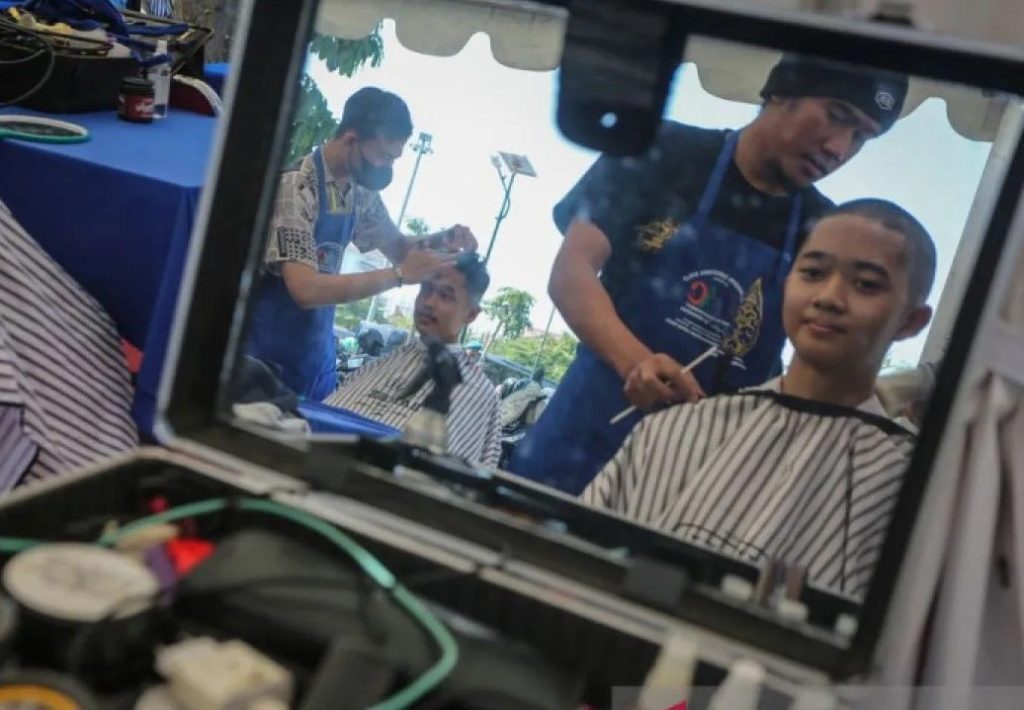
His prime examples were neighborhood barbers and salons that deal in cash and collect no value-added tax (VAT). The political appeal is obvious: targets sit on every street corner, and the remedy sounds inexpensive.
In reality, micro-entrepreneurs will register only if the state first provides a tangible return linked directly to compliance. Political economists call this reciprocity a fiscal contract: citizens pay, and the state delivers benefits they can actually feel.
Revenue concerns are undeniably justified. Indonesia’s tax-to-GDP ratio, including customs and excise, stood at just 9.31 percent in 2025. For 2026, the government projects tax collections will fall approximately Rp 47 trillion short of its target.
Yet the Rp 1.5 quadrillion figure rests on a flawed premise: comparing Indonesia’s revenue ratio directly with Cambodia’s. A peer gap illustrates relative performance; it does not measure untaxed capital flight or evasion. World Bank estimates place Indonesia’s shadow economy closer to a fifth of GDP, far below the 30 to 40 percent mark.
If the state wants to recover missing revenue, corporate balance sheets are where it should look. The World Bank estimates that corporate income tax compliance losses averaged Rp 160 trillion annually between 2016 and 2021, roughly one-third of total corporate tax obligations. Research by The PRAKARSA further revealed that trade misinvoicing in coal and fisheries alone cost the state Rp 74 trillion between 2012 and 2021.
The World Bank identified the largest shortfall in VAT compliance, which averages Rp 386 trillion annually and is partially tied to informality. The report highlights the current Rp 4.8 billion VAT registration threshold as a key driver, as many enterprises intentionally cap their reported turnover just beneath the ceiling.
While the finance minister can adjust this threshold by regulation, simply lowering it would be a mistake. Enterprises hovering near the boundary require a graduated, simplified VAT mechanism to prevent disruptive compliance shocks. A neighborhood barber operates far below any rational VAT threshold.
Ill-conceived shortcuts also risk undermining Indonesia’s financial inclusion infrastructure. When Ghana instituted a 1.5 percent levy on electronic transactions in May 2022, mobile money volumes plummeted by an estimated 30 to 50 percent in the short term, forcing Accra to slash its annual revenue target from 6.96 billion cedis ($509 million) to just 611 million. Indonesia does not tax fund transfers, but an ill-advised signal about a “digital tax” would be enough to trigger a retreat into cash.
Enforcement remains vital, but it must be applied where it matters most: at the top. Empirical evidence from developing economies shows that reducing administrative hurdles brings in marginal formalization, while the bulk of fiscal recovery from enforcement stems from uncovering large, hidden commercial enterprises. The Directorate General of Taxes should focus its resources on companies concealing billions in turnover, not on the local barber’s chair.
For micro and small enterprises, program design dictates the outcome. Brazil consolidated multiple taxes and social security contributions into a single, discounted flat rate under SIMPLES, driving a sharp rise in formal registration. Uruguay extended healthcare coverage to the children of formal workers, lifting eligible formal employment by 1.6 percentage points, with resulting state revenues comfortably outpacing losses from underreported wages.
Conversely, Mexico provides a cautionary tale: its Seguro Popular offered subsidized health coverage with no requirement of formal employment. The highest estimates suggest the program crowded out roughly 300,000 formal jobs, though conservative estimates place the impact lower.
Indonesia has an equivalent arrangement: the PBI scheme under National Health Insurance (JKN) covers premiums for low-income citizens regardless of employment status. This should remain intact; basic social safety nets must stay unconditional, particularly for day laborers and home-based workers facing steep registration hurdles. Value-added incentives for formal tax registration must complement this baseline, not replace it.
This is where domestic policy falls short. The government already extends substantial support to small businesses, from the 0.5 percent final micro-turnover tax to subsidized People’s Business Credit (KUR) facilities. Yet the formalization conditionality applies only at higher brackets: a taxpayer identification number (NPWP) is required only for KUR loans exceeding Rp 50 million, and BPJS Ketenagakerjaan enrollment is mandated only above Rp 100 million.
A micro-entrepreneur borrowing Rp 20 million is never asked for tax credentials, nor given any clear incentive to register. Unsurprisingly, as of May 2026, 59.3 percent of Indonesian workers remained in the informal sector, while BPJS Ketenagakerjaan covered barely a tenth of them as of mid-2025.
The state already possesses the tools to extend the fiscal contract downward. Since Oct. 1, major digital platforms have automatically withheld 0.5 percent income tax from online merchants. While individual sellers with annual turnover below Rp 500 million remain exempt, they still submit their national identification (NIK) or NPWP during onboarding. Offline vendors like barbers and food stalls can be integrated through existing rails, such as QRIS merchant registrations or Business Identification Numbers (NIB) under the Online Single Submission (OSS) platform.
These databases should serve as the gateway. The Finance Ministry and BPJS Ketenagakerjaan could subsidize social protection contributions for newly registered micro-vendors. For micro-loans, state banks could offer preferential KUR interest rates to borrowers who integrate their NIK with the tax registry, an easy, zero-cost online step, avoiding hard mandates that would otherwise push them back into informality. Meanwhile, the House of Representatives should require rigorous cost-benefit auditing for the Rp 141 trillion spent on business and investment tax incentives.
State revenues must expand, but through smart institutional design rather than coercion. The government already applies the logic of the fiscal contract to corporate and upper-tier borrowers; it is time to extend the same deal to the neighborhood barber, leading with tangible value rather than an audit notice.
_______________________
This article was published in thejakartapost.com with the title “Taxing the barber will not close Indonesia’s revenue gap”.