

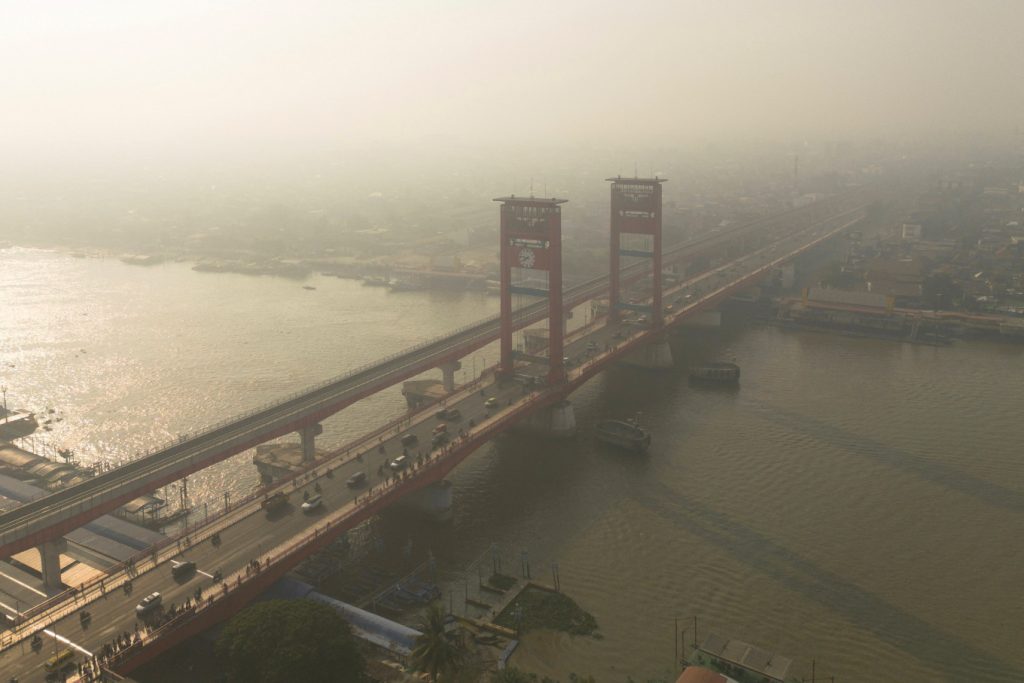
The forest fire cycle in Indonesia usually ends when the first rains fall and the emergency posts close. The government announces that the fires are under control, and public attention moves elsewhere. For many families in Sumatra and Kalimantan, the epicenters of the disaster, that is when their health problems start to pile up.
The Health Ministry recorded 174,694 cases of acute respiratory infection between Aug. 18 and Sept. 21 in seven fire-affected provinces, four of them in Kalimantan. More than 40,000 of the cases were in children under five. Those figures count people who reached a health facility while the smoke was still thick. They leave out the deferred burden: children taken to a clinic weeks later, or never taken at all.
The 2015 fires show what that burden looks like. Sambodo et al. examined national health insurance claims across Sumatra and Kalimantan, and found the clearest changes in the six months after the fires ended. Compared with pre-fire levels, primary care visits by young children rose by about 17 percent, while their hospital visits fell by about 16 percent.
The rise was concentrated in cities and the fall in rural areas. The researchers read this as a sign that many rural children missed the care they needed, and urged the government to focus on helping them catch up once the fires subsided.
Some of the burden only appears much later. Rosales-Rueda and Triyana followed children exposed to the smoke of the 1997 fires. Years afterward, those children were shorter and had lower lung capacity than children from areas without haze. Those exposed in the womb were still shorter 17 years on.
PRAKARSA’s research helps identify who is most likely to carry this burden. Our report, “Broad Coverage, Fragile Protection: Indonesia’s Universal Health Coverage in 2024”, shows an island sharply divided.
On the index of health service capacity and access that we compiled, North and East Kalimantan rank among the top six provinces nationally. West Kalimantan, where nearly half of Indonesia’s hotspots were recorded in late August, ranks fifth from the bottom of 38 provinces. It has about 11 hospital beds for every 10,000 residents, compared with our index benchmark of 18, and one of the lowest densities of health workers in the country.
The 2023 Indonesian Health Survey (SKI) measures access with an index that accounts for, among other things, travel time and cost. In West and Central Kalimantan, nearly half of assessed households fall into the “very difficult” category for reaching a community health center. Outside Papua and East Nusa Tenggara, no province does worse. For hospitals, Central Kalimantan ranks third-hardest in the country. If children in these two provinces need to catch up on care once the haze lifts, they start from farther away than almost anyone else.
Health services there were already struggling to keep patients in care before the fires. In West Kalimantan, only about one in four children aged 12 to 23 months has completed basic immunization. In Central Kalimantan, the same survey found that just 12.6 percent of people with hypertension have their blood pressure under control, the lowest of all 38 provinces.
At the end of 2024, according to the National Social Security Council, 98.45 percent of Indonesians were registered with the National Health Insurance program (JKN), but active membership covered only 78.83 percent. In West Kalimantan, more than a third of SKI respondents said they had no health insurance at all. Picture a family that finally brings a child to the clinic a month after the smoke clears, only to hear from the registration desk that their card is inactive.
There is also a financing gap that rarely gets discussed. JKN rules exclude care arising from disasters during the emergency response period, so care in that period depends on disaster funds. The deferred burden, however, surfaces after the emergency status is lifted, once the posts have closed and the disaster money has stopped.
From then on, families pay their own way from village to clinic, including meals and lodging for a relative if the patient is referred to a city hospital. Our report recommends that JKN cover transport and accommodation for referred patients. The months after a fire season are when that recommendation matters most.
Health spending data also need careful reading. We found that the share of residents facing catastrophic health spending is lower in West and Central Kalimantan than in East and North Kalimantan. Where access is this difficult, a low figure can mean people are not getting treated at all, so neither their costs nor their illnesses get recorded.
We cannot yet measure how often that happens. Local governments should not take the figure as proof that their residents are protected.
The fire response needs a health recovery phase once the emergency ends. Health offices could start with the list of toddlers treated for respiratory infections during the haze season and make sure they return for follow-up and complete their immunizations.
Community health centers should also contact chronic patients who stopped collecting their medication while the smoke was thick. The government and BPJS Kesehatan need to agree in advance on who pays when care shifts from disaster funds back to JKN, while speeding up the restoration of eligible subsidized members whose coverage has lapsed.
Transport support should continue for several months after the posts close, since families need it most when they are catching up on care. For children exposed to heavy smoke, growth and lung checks could be added to the routine visits they already make to village health posts.
Final reports on fire response tend to stop at the total area where fires were extinguished. Local governments are supposed to also report how many affected toddlers were seen again within six months of the fires, and what their families spent to get them there.
The first rains will soon put out what remains of the fires in West and Central Kalimantan. The government should wait before declaring success, at least until children in the most remote villages have caught up on delayed care.
***
Bintang Aulia Lutfi. The writer is a senior researcher at The PRAKARSA, and the author of the report “Broad Coverage, Fragile Protection: Indonesia’s Universal Health Coverage in 2024”.
This article was published in thejakartapost.com with the title “When the fires are out, the health bill comes due”.